
How to Disagree Without Being Disagreeable
I thought I’d kick this year off with a fun post. A light hearted missive about something we all love…disagreements (not!). But with a twist. How we can disagree, without being disagreeable.
Now we’re through the holiday period and settling back into the arm chair of work, the business of making shit happen has to be fired back up. And that, no matter what we hope for, will involve navigating disagreements.
We disagree when two or more people have different perspectives, ideas or needs that have to be aligned to make progress. They become challenging when progress (for or against) is deeply meaningful to each party. Emotions can then get involved and rational minds give way to warring minds. The result is often not pretty.
So, how can we use disagreements for their positive attributes, and ditch the parts that we don’t like? Let’s unpack this and learn a strategy to disagree constructively in any situation.
What makes disagreeing hard?
Most people don’t struggle with disagreement because they lack confidence or intelligence. They struggle because disagreement feels unsafe. Disagreements force us to confront our own limitations in a way that can be deeply uncomfortable.
The real problem isn’t disagreement itself. It’s that many of us are unaware of how we disagree, and the impact our style has on others and the outcomes we achieve. Under pressure, disagreement can quickly turn into something else: a win–lose contest where protecting our position matters more than improving ourselves and the situation.
When that happens, we become disagreeable rather than effective. And that shuts down progress, not enables it. When stakes are high, this is often the default we fall to. But this comes at a high cost. It blocks learning, stifles creativity, and damages relationships.
Disagreement Styles
I used to hate disagreements. They made me feel awkward and unsafe at times depending on the person I was disagreeing with. Whenever one came up, mostly I’d freeze and not participate fully. For the longest time I didn’t understand why. I still had them, but it was like walking over broken glass each time. I realised I wasn’t giving my full self to the “discussion” at the time which made me feel really annoyed at myself afterwards.
About a decade ago, I decided to stop avoiding disagreement and start understanding it. I wanted to know why it affected me so strongly, what skills I was missing, and which beliefs were quietly undermining me.
What I discovered changed the way I approach disagreement, and how I coach others who struggle with it. I call it the Disagreement Style Model. It’s a simple framework that helps you recognise your default approach to disagreement, understand how it lands with others, and shows you how to engage in disagreements more safely and productively.
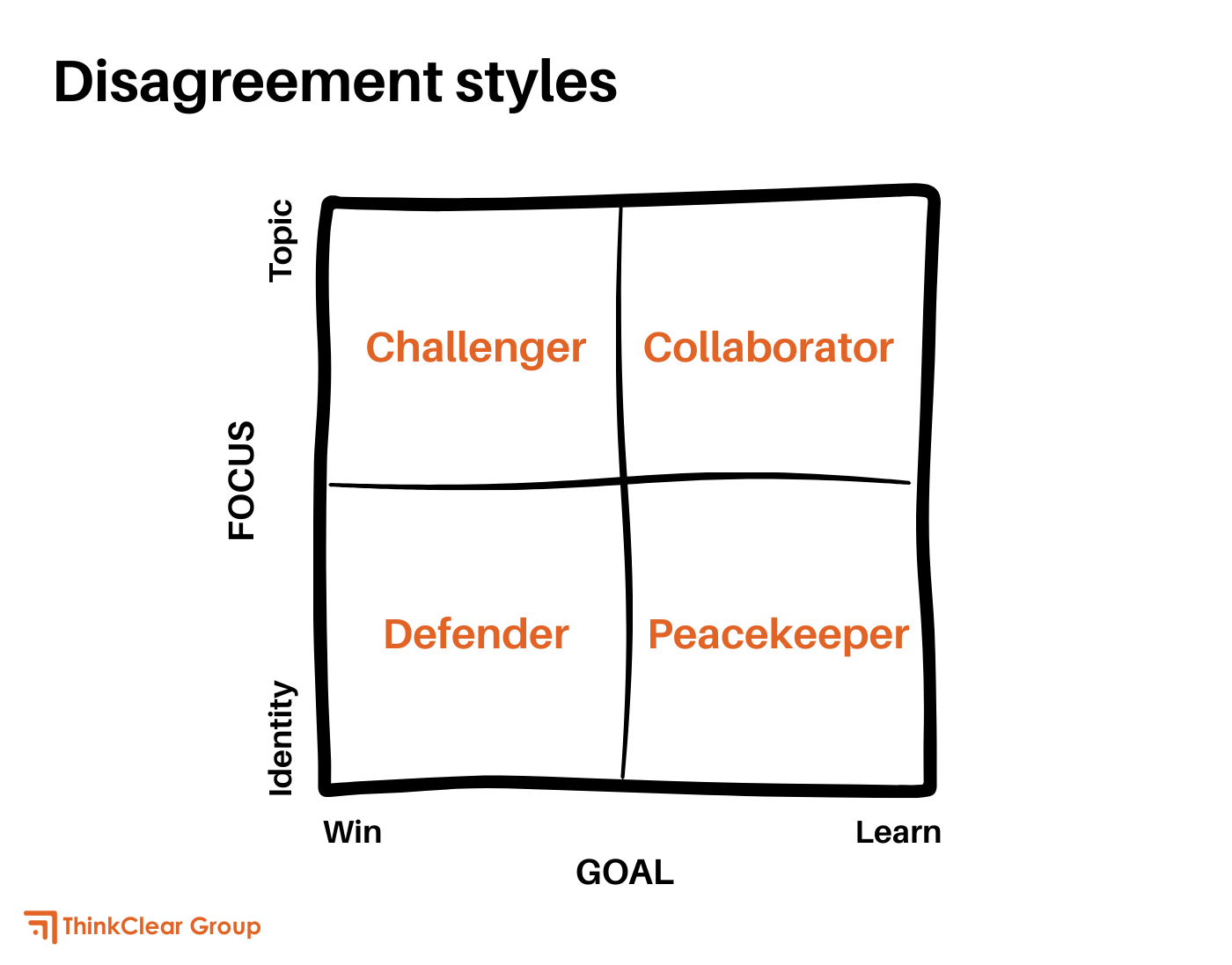
The model identifies four disagreement styles: Defender, Challenger, Collaborator, and Peacekeeper. Each reflects a different set of beliefs and internal dialogue that shapes behaviour, body language, tone of voice, and ultimately outcomes. All four can achieve results, but they come with very different costs. Becoming aware of your style is the key to learning how to disagree without being disagreeable.
1. The Defender
The Defender style is motivated by winning and focused on self-protection. The internal dialogue sounds like:
“I can’t be wrong. If I give in, I’ll look incompetent.”
In Defender mode, your attention is on how you appear to others. You react quickly when challenged, interrupting, justifying, or pushing back hard to protect your reputation or ego rather than to find the best outcome.
This is the most disagreeable style. It’s high energy, emotionally charged, and creates a clear winner–loser dynamic. When leaders default to this style, teams quickly learn it’s unsafe to raise alternative perspectives or surface problems.
The beliefs driving this style are often unconscious. That admitting error equals weakness, or that credibility depends on being right. Young leaders are often susceptible to this style early on in their careers. When disagreement becomes personal, most people drift into Defender mode. The telltale signs this approach has drifted into dysfunction is when you start using contempt to respond. Rolling eyes, using sarcasm, or showing dismissive body language which undermines trust and triggers defensiveness in others.
2. The Challenger
The Challenger style is when you are also motivated by winning, but your focus stays on the topic rather than defending your identity. Your inner dialogue sounds like:
“I know their idea is flawed. I need to push back to get them to see how my idea is better. My value is in being right.”
Challengers test assumptions, ask tough questions, and push for rigor. This style is valuable in high-stakes situations where accuracy, accountability, or managing risk matter. The underlying belief in adopting this style is that the quality of the idea matters more than personal comfort.
The risk of this style is in the tone of delivery. Without care, Challenger energy can come across as aggressive or dismissive, even when intentions are good. The skill lies in balancing assertiveness with respect, keeping challenges focused on ideas, not people and knowing when the discussion has reached diminishing returns and its time to hit pause.
3. The Collaborator
The Collaborator style is best used when you’re motivated by learning, open to opposing viewpoints and focused on the topic. Your internal dialogue is curious:
“I want to understand what’s going on here. My view may not be the right one. Together I’m sure we can find the best answer.”
This style involves active listening, inviting different perspectives, offering alternatives, and co-creating solutions. Collaborators believe that shared understanding produces the best outcomes, which allows them to stay calm, open, and constructive, even under pressure.
This is the most effective way to start a disagreement. It rarely triggers defensiveness and builds trust quickly. The limitation is time. When constraints are tight or urgency is high, too much exploration can become frustrating. Awareness of context, and others’ capacity, matters.
4. The Peacekeeper
The Peacekeeper style is where you are motivated by learning how to find the right outcome from the disagreement but also concerned with self-protection and maintaining harmony. In this mode your internal dialogue says:
“I want to understand, but I also don’t want to upset anyone or create tension.”
In Peacekeeper mode you tend to yield quickly, withdraw, or defer to others judgement or perspectives, even when you have valuable different insights because the discomfort of prolonged disagreement outweighs the desire to contribute. This is often a survival strategy in politically sensitive or high-risk environments where it doesn’t feel safe to disagree. You raise an issue, but then preface it with words like, “this probably isn’t a big deal, but…” This undermines the value of your insight before the discussion starts.
The belief underneath this style is that safety and relationships matter more than asserting ideas. Over-reliance on this style can lead to missed opportunities, unresolved risks, poorer decisions and over time, deep resentment. The key to growth here is to shift the beliefs that cause you to feel unsafe when your opinion differs to others.
Three Ways to Disagree Without Being Disagreeable
Check Your Motivation
Pause and ask yourself: Am I trying to win, or am I trying to learn and improve? Shifting your mindset to curiosity immediately reduces your defensiveness and that of others.Separate Topic from Identity
Focus your questions and words on challenging ideas and actions, not people. Frame disagreement around data, outcomes, or assumptions rather than personal critique.Agree Importance and Invite Difference
Find a platform to agree on first. An effective one is that you agree this is an important topic. Then invite a discussion of differences, not a debate of correctness.
Disagreements aren’t destructive, they’re opportunities to make progress. If you feel uncomfortable in them, it’s often because hidden beliefs make you feel unsafe. Like they did with me. The first step is noticing those beliefs and choosing a mindset that best serves the situation you’re in. When you do, you become someone people want to disagree with, because every disagreement becomes a chance to learn, improve, and grow together.
Learning to disagree without being disagreeable doesn’t just make you easier to work with, it makes you a more effective leader.